
Little Devils
Of Magic and Infernal Posters

There is a famous 1894 poster of Harry Kellar where the great magician looks out with that grand, pale, Victorian seriousness that said, “I know something you do not, and no, I shall not be explaining myself to the likes of you.” Around him are two little red imps. One peeks from his shoulder. The other leans into his ear, whispering. Not shouting. Not threatening. Whispering. That is the important bit, because these are not devils dragging a sinner into perdition. They are consultants. Infernal stage managers. Tiny red agents of publicity, crouched around Kellar like they have the real secrets and he is merely the well-dressed human authorized to handle the receipts.
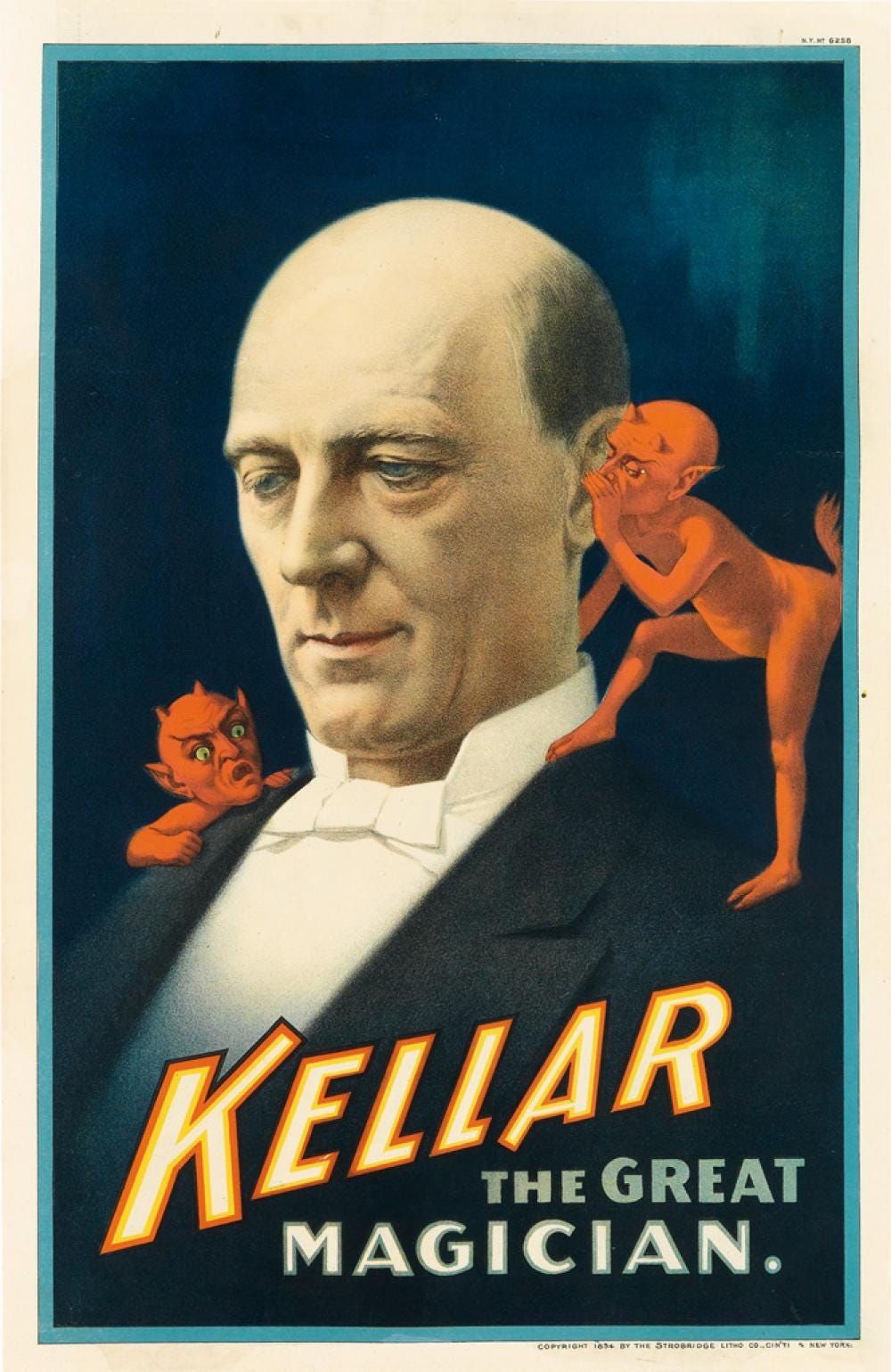
It is one of the great images of Golden Age magic advertising, and also one of the funniest if you let yourself stare at it a little too long, which I recommend. Kellar’s expression is not terror. It is not even surprise. He looks faintly inconvenienced, as if the devil may have the secrets of the universe, but Kellar has heard the notes already and would like to get on with the show. The poster, printed by Strobridge Lithographing Company in 1894, is often treated as the beginning of the “whispering imps” tradition in magic posters. As with most beginnings in magic history, one should say that carefully, because earlier devilish imagery was already circling the room with a drink in its hand. Alexander Herrmann had supernatural and diabolical material around him before Kellar’s most famous imp poster, and theatrical posters had been flirting with demons, skeletons, ghosts, and the occult for years. Still, Kellar seems to have done the thing that matters commercially. He made the little devils into a brand.
The documentary Before Houdini, One Man Ruled the Stage makes a useful point around the thirty-one-minute mark: the imps were not merely decoration. They were part of the birth of a recognizable magic poster language. That matters, because the image did not just say, “Here is Harry Kellar.” It said, “Here is Harry Kellar, and he knows something because something else told him.” That is an entire mythology in one theatrical portrait. Kellar was not presented as a clownish trickster, not a carnival operator, not a dusty professor with a box of puzzles. He was the calm human center of a supernatural conspiracy, and the joke was that everyone could see the conspiracy except, apparently, the authorities.
The frustrating little historical goblin here is that the individual artist behind that first famous Kellar imp poster does not seem to be named in the usual catalog records. The Library of Congress credits the piece to Strobridge & Co. Lith., and Swann Galleries lists the designer as unknown. That is not unusual, but it is annoying in the way history so often is, handing us the object and then misplacing the person. Strobridge was not a lonely artist in a garret having a feverish vision over cold coffee. It was a commercial lithography powerhouse, based in Cincinnati with New York offices, famous for theatrical and circus posters. Its staff artists, lithographers, color workers, letterers, designers, and pressmen produced images meant to shout from walls, fences, windows, and train stations. Much of that work came out under the company name rather than the name of whoever sketched the curve of an imp’s tail.
That makes the design more interesting, not less. Whoever built that poster understood Kellar’s face as the product. The composition is essentially a bust portrait: black formal coat, white shirtfront, bald head, direct gaze, clean theatrical dignity. Then the artists vandalized that dignity, beautifully, by adding two red devils at his shoulders. The contrast does half the work. Kellar is pale, still, formal, almost clerical in his composure. The imps are red, restless, bent toward him, all elbows and secrets. The human center is calm. The supernatural edges are busy. The eye lands first on Kellar’s face, then notices the imps, then understands the joke: he is not merely performing tricks. He is being briefed by Hell’s smallest committee.
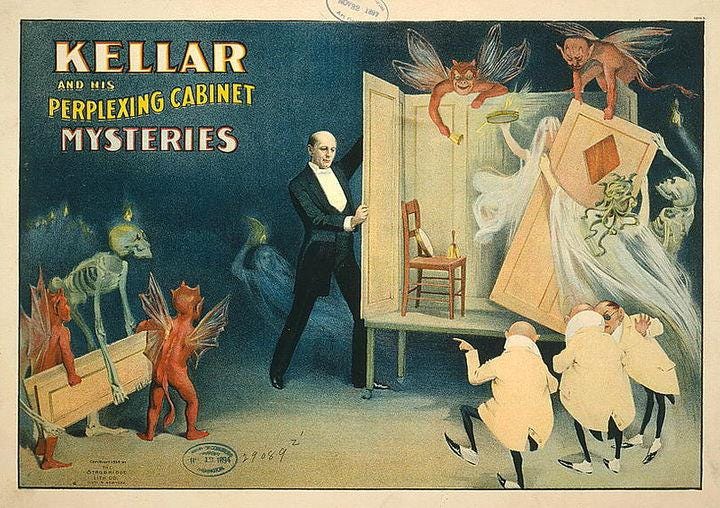
There is something wonderfully efficient about that design. The poster does not need a full theatrical scene. It does not need a cabinet, a floating woman, a skull, a séance table, a thundercloud, or a committee of alarmed gentlemen losing their hats. It needs only the magician, the whisper, and the suggestion that the secrets are coming from somewhere improper. The imps are not large enough to overpower him. They are not demonic villains in the grand religious sense. They are pocket devils. Manageable devils. Useful devils. A full-sized Satan is too much. That becomes church trouble. An imp can perch on a shoulder and still leave room for the ticket price.
Kellar did not invent the public association between magic and the infernal. That goes back much further, to old fears about conjurers, cunning folk, forbidden books, stage charlatans, village tricksters, and the suspicious fellow at the fair who could make an egg appear from someone’s ear while somehow looking guilty about it. What Kellar and the poster artists of the Golden Age did was modernize the accusation. They took the ancient suspicion, “the magician is in league with devils,” and turned it into box office. That is show business at its sharpest, really. Take the thing people fear, trim it, color it, frame it, then sell balcony seats.
By the late nineteenth century, stage magic had become a polished theatrical business. The magician was not, at least in theory, a sorcerer muttering in a cellar over a bowl of goat-related inconvenience. He was a performer. A showman. A man in evening dress. The top hat and tails were a kind of legal defense. “Gentlemen, clearly I cannot be trafficking with demons, I am wearing a white bow tie.” But the posters told a more exciting lie, and good advertising has always preferred an exciting lie over a responsible paragraph of explanation. The Golden Age of magic, usually placed somewhere from the 1880s into the 1930s, was a period when magicians became touring celebrities and their posters had to do the work of a thunderclap. These were not small social media graphics wheezing politely through an algorithm. These were huge color lithographs slapped onto the sides of public life. They needed to stop people in their tracks. They needed to say, “Tonight, in this very theater, the laws of nature will be mildly bullied.”
So the artists gave the public what it wanted: levitations, skeletons, vanishing women, floating heads, occult books, black cats, ghostly vapors, impossible cabinets, and devils. Especially devils. Kellar was ideal for this treatment because he already looked like someone who had read the wrong book and enjoyed it. His bald head, severe eyes, and carefully composed dignity made him less like a frantic entertainer and more like a priest of impossible machinery. Put a few imps around him and he became a man receiving forbidden intelligence from below. The poster did not say, “Here is a practiced illusionist using stagecraft.” It said, “This man has friends in warm places.”
Audiences understood the game. That is the part modern readers sometimes miss. The devil imagery was not necessarily a confession of occult practice, nor was it simply religious panic dressed in red tights. It was a theatrical thrill. A safe flirtation with forbidden knowledge. The audience could enjoy the suggestion of danger without actually bringing home damnation in a hatbox. It was the same delicious contract as a ghost story told by candlelight. Nobody wants the ghost to be real real. That would ruin the evening and possibly the upholstery. But the suggestion? The shiver? The idea that we are all civilized adults sitting in respectable seats while something uncivilized scratches at the wallpaper? That sells tickets.
The imps also solved a marketing problem. How do you visually represent the source of magical knowledge? You can show props, but props look like props. You can show the magician with cards or rings or a lady floating horizontally, which is useful, but it explains nothing. The shoulder imps offered a tidy little myth: the magician knows because secret beings tell him. The devils whisper what the audience is not allowed to hear. That is the engine of magic in one picture. Knowledge divided unequally, with the audience on the wrong side of the curtain.
This is why the whisper matters more than the horns. A devil screaming at a magician would make him a victim. A devil whispering makes him an accomplice, and accomplices are much more interesting on posters. Kellar used that accomplice image brilliantly. In one poster he stands near a great open book while red devils gather around it, as if studying the footnotes of Hell. In another, he appears with Mephistopheles, sharing wine like two old clubmen after a profitable séance. In his levitation posters, rows of little red devils bow at his feet while he raises a woman into the air. They are not there because the illusion needed demons. They are there because the public needed a reason to believe the illusion belonged to something larger than ropes, rods, mirrors, trapdoors, and the practiced cruelty of rehearsal.
That is the funny thing about good magic advertising. It does not explain the trick. It explains the feeling. Once Kellar’s imps entered the visual vocabulary, other magicians adopted the device. Herrmann, Thurston, Blackstone, Dante, Carter the Great, the Great Raymond, and others all moved through related supernatural poster imagery. Sometimes the devils whispered. Sometimes they hovered. Sometimes they looked like stagehands with better cheekbones and worse theology. By the time Howard Thurston inherited Kellar’s mantle in the early twentieth century, the public had already been trained to understand the code. Red devils meant secrets. Skulls meant spirits. A magician with a book meant knowledge. A magician with a devil meant knowledge you probably should not have, which is of course the best kind for advertising purposes.
It helped that the culture around them was already thick with Spiritualism, séances, psychic claims, religious anxiety, and new technologies that felt almost supernatural to ordinary people. The nineteenth century did not merely believe in progress. It believed in progress while holding a planchette. People were fascinated by electricity, photography, telegraphy, invisible forces, ghostly communication, hypnotism, psychic powers, and the general suspicion that the universe had a backstage entrance. Magicians exploited that fascination while also exposing fraudulent mediums, borrowing their atmosphere, and occasionally selling tickets to the very people who wanted to be fooled and then congratulated for not being fooled too completely. A neat trick, that.
The poster artists were working inside that charged little storm. They knew that magic had to appear respectable enough for the theater and wicked enough to be worth leaving the house. Kellar’s imp poster gets that balance almost perfectly. The portrait says civilization. The imps say trouble. The tuxedo says trust me. The devil says perhaps do not. And between those two signals sits stage magic itself, smiling politely while hiding the gimmick in plain sight.
The posters were not sermons. They were not theological statements. They were commercial art with a wicked little grin. They offered the forbidden in bright ink, trimmed it down to a theatrical size, and gave it a pair of horns. The devil had become a mascot. Not Satan as cosmic enemy, not the grand adversary of theology and opera, but the imp: small, manageable, comic, useful. An imp can hold a book. He can whisper. He can be spooky without shutting down the fun. He gives the magician danger in miniature, the occult as pocket furniture.
That is why the image has lasted. Modern magic has spent decades trying to look clean, clever, psychological, scientific, minimalist, or “interactive,” which is often code for “the lighting is blue and someone says influence a lot.” Nothing wrong with that. But I do miss the old bargain sometimes. The magician as a person who stands between worlds, pretending not to notice the small red creature giving him cues. The Golden Age posters understood something we forget at our peril: magic needs atmosphere. Not clutter. Not fake profundity sprayed from a theatrical fog machine. Atmosphere. A sense that what is about to happen belongs to an older, stranger room than the one the audience walked into. Kellar’s devils did that instantly. One glance and you knew you were not simply buying a demonstration of tricks. You were buying proximity to a secret.
Were the imps silly? Absolutely. Gloriously silly. But silliness and mystery are not enemies. They are drinking companions. A tiny devil whispering into a bald magician’s ear is absurd, yes, but it also tells the truth about the art. Magic is always a whisper. It says, “Come closer. You are missing something.” Then, when you do come closer, it pockets your certainty and smiles like it has done nothing wrong. Kellar knew this, or at least his poster artists did. The magician does not need to claim supernatural power outright. He only needs to allow the public to wonder where the knowledge comes from, and there on the shoulder is a little red answer. Not enough to convict him. Just enough to sell the show.
Sources
Library of Congress, “Kellar,” 1894
https://www.loc.gov/pictures/item/2014635607/
Library of Congress, Magic Poster Collection
https://www.loc.gov/pictures/item/95861316/
Sotheby’s, The Ricky Jay Collection, “Kellar, Harry (Heinrich Keller) | The first portrayal of imps whispering secrets to a magician”
https://www.sothebys.com/en/buy/auction/2021/the-ricky-jay-collection/kellar-harry-heinrich-keller-the-first-portrayal
Swann Galleries, “Designer Unknown. Kellar the Great Magician. 1894.”
https://www.swanngalleries.com/auction-lot/designer-unknown.-kellar-the-great-magician.-1894_5624d9a817
Smithsonian Magazine, “The Amazing Poster Art From the ‘Golden Age’ of Magic”
https://www.smithsonianmag.com/arts-culture/art-golden-age-magic-posters-180974304/
Public Domain Review, “Harry Kellar’s Show Posters”
https://publicdomainreview.org/collection/harry-kellar-s-show-posters/
Rhett Bryson, “Whispering Imps on Magic Posters”
https://rhettmagic.furman.edu/impimages.html
PBS American Experience, “Harry Kellar (1849-1922)”
https://www.pbs.org/wgbh/americanexperience/features/houdini-kellar/
University of Cincinnati Libraries, Strobridge History
https://libapps.libraries.uc.edu/exhibits/shepherd/strobridge-history/
YouTube, Before Houdini, One Man Ruled the Stage | Harry Kellar | Full Documentary, discussion of imps and magic iconography around 31:00